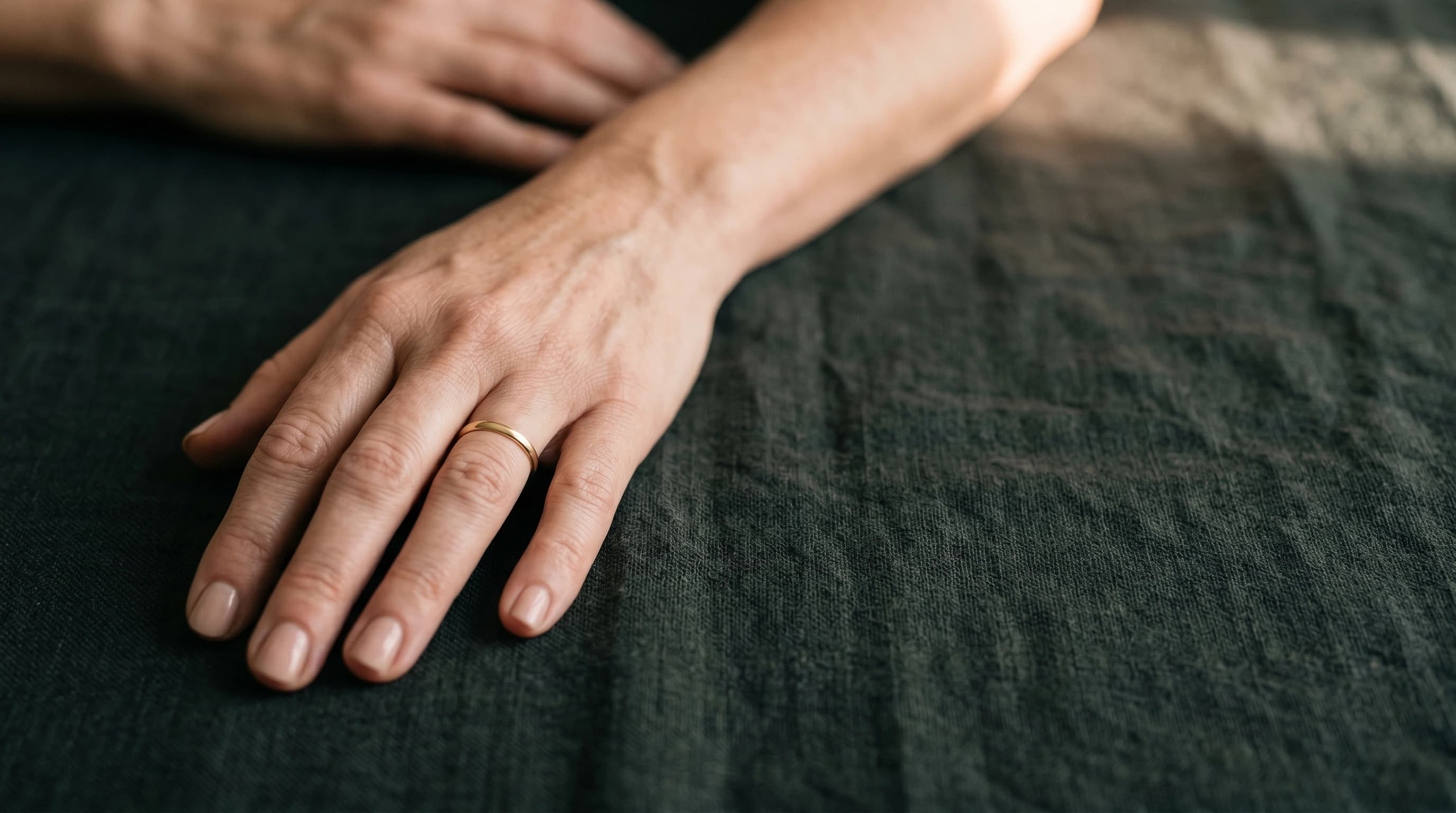
Lipofilling · permanent · approx. 1.5 h, outpatient
Natural, long-lasting rejuvenation of the hands by injecting your own fat — building volume, softening the appearance of tendons and veins, smoothing the surface of the skin.
Treatment
What is Hand rejuvenation with fat transfer?
Hand rejuvenation with fat transfer (lipofilling of the hands) is the surgical method for restoring volume naturally to the back of the hand — a permanent alternative to injecting hyaluronic acid. At the Ästhetik am Isartor practice in Munich the procedure is carried out under the medical direction of Dr. Fabian Weinschenk. With advancing age the hands lose fatty tissue and collagen — tendons, veins and bones stand out more, and the skin looks thin and slack. Conventional wrinkle treatments with hyaluronic acid last only a limited time on the back of the hand; fat transfer offers a long-term alternative. The procedure has three steps: liposuction of a small quantity of fat from a suitable donor site (abdomen, hip or thigh), preparation by centrifugation, and targeted micro-fat injection with fine cannulas into the back of the hand. It takes about 1.5 hours under local anaesthetic, as an outpatient. Exercise pause 1–2 weeks, final result after 3–6 months — once the fat has fully integrated. Part of the transplanted fat is resorbed by the body (typically 30–40%); the integrated portion is retained long term.
Suitability
Who is Hand rejuvenation with fat transfer suitable for?
With advancing age the hands lose fatty tissue and collagen. Tendons, veins and bones stand out more, and the skin looks thin and slack. Hyaluronic acid injections on the back of the hand last only a limited time (4–6 months) — fat transfer offers a permanent alternative: an integrated part of the transplanted fat is retained long term.
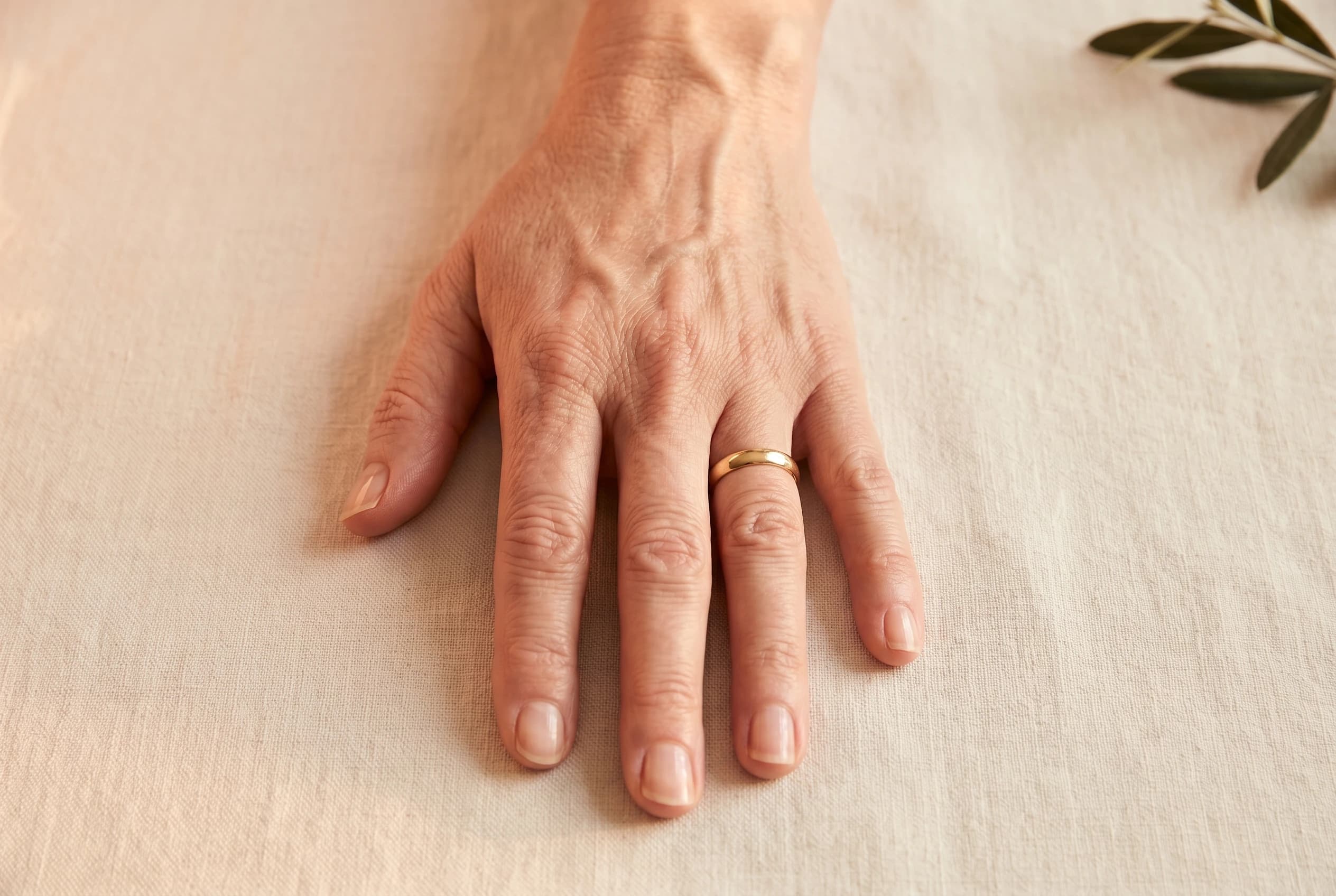
Suitable for
Hand rejuvenation with fat transfer is suitable where there are pronounced hollows / visible tendons and veins on the hand through age-related loss of volume, a general volume deficit on the back of the hand without bony change, a wish for a permanent procedure instead of a six-monthly hyaluronic acid top-up, sufficient donor fat on the abdomen, hip or thigh, and realistic expectations — fat transfer delivers a natural, long-lasting result, but not the complete disappearance of the structures of the hand. Preconditions: stable general health, being a non-smoker or abstaining from nicotine during the integration phase.
Not suitable for
Hand rejuvenation with fat transfer is not appropriate with blood-clotting disorders or active anticoagulation that cannot be paused, with acute infections at the donor or recipient site, in pregnancy or while breastfeeding, where there is insufficient donor fat (a very slim build), with pronounced skin laxity of the hand without a volume deficit (fat transfer is not the right procedure for that) and where there is a wish for a short-term or reversible result — hyaluronic acid is the right option for that. For smokers we recommend abstaining from nicotine for 4 weeks before and after the procedure, because nicotine impairs the integration of the fat.
Whether hand rejuvenation with fat transfer or a shorter-lived hyaluronic acid variant makes more sense for you is something we decide together in the personal initial consultation (€100).
Method
Three steps. One material from your own body.
The lipofilling is carried out as one combined procedure in three clearly separated steps — fat harvesting at a suitable donor site, gentle preparation and precise micro-fat injection into the back of the hand.
Harvesting
Fat harvesting (liposuction at the donor site)
- How it works
- Gentle liposuction of a small quantity of fat (20–40 ml per hand) from the abdomen, hip or thigh through 2–3 mm incisions.
- Strength
- A double benefit — a slight contour correction at the donor site as a side effect
- Areas
- Abdomen · hip · thigh
Preparation
Sterile preparation (centrifugation)
- How it works
- Centrifugation and separation of fluid, blood components and viable adipocytes — only the cleaned micro-fat is re-injected.
- Strength
- Maximises the vitality of the transplanted fat cells · a higher rate of integration
- Areas
- A sterile operating setting
- Minimally invasive
Injection
Micro-fat injection (back of the hand)
- How it works
- Re-injection of the prepared micro-fat with fine microcannulas into precisely defined depth planes — distributed layer by layer, not into a single depot.
- Strength
- Natural volume · visibly fewer tendons and veins · a smoothed skin surface
- Areas
- Both backs of the hands (typically in one session)
Part of the transplanted fat (typically 30–40%) is resorbed by the body over the first months — the integrated portion is retained long term. Where a considerable proportion is resorbed, or where more volume is wanted, a second session is possible after 6 months.
Fat transfer vs. hyaluronic acid
From your own body. Long-lasting. A genuine investment.
Fat transfer uses your own tissue and integrates permanently in part — unlike hyaluronic acid fillers, which are broken down completely on the back of the hand after 4–6 months. The trade-off: lipofilling is minor surgery (liposuction + injection), while hyaluronic acid is a pure injection treatment with no donor site. For patients who would rather not return for a hyaluronic acid top-up every 6 months, fat transfer is the more efficient solution.
Your own fat integrates into the tissue for the long term. Hyaluronic acid is broken down by the body and has to be topped up when needed. The choice depends on the goal and on how long you want it to last.
Procedure
How the procedure works
Four clearly separated steps — from the initial consultation with the choice of donor site, through the combined procedure (liposuction + preparation + injection), to the aftercare.
 Schritt 01approx. 45 min.
Consultation & planning
In the personal initial consultation (€100) we establish the volume deficit on the back of the hand, assess the quality of the skin and choose a suitable donor site for the fat harvesting together (abdomen, hip or thigh). Mandatory information under § 8 HWG (German Health Advertising Act) is handed out.
 Schritt 02
Preparation on the day of the operation
Marking of the donor site and of the target area on the back of the hand with the patient upright. Skin disinfection, sterile draping. Local anaesthetic at the donor site and on the back of the hand. On request, additional calming oral medication.
 Schritt 03approx. 1.5 h
Liposuction · preparation · injection
Liposuction of the donor fat through 2–3 mm incisions (typically 20–40 ml per hand). Sterile centrifugation of the harvested fat in theatre. Re-injection of the prepared micro-fat into the back of the hand — distributed layer by layer with fine microcannulas, not into a single depot.
 Schritt 04
After the procedure
A dressing on the hand and the donor site immediately after the operation. Swelling and bruising are typical in the first 7–10 days. Exercise pause 1–2 weeks; avoid heavy use of the hands for 2–3 weeks. Everyday activities are possible again promptly.
Facts
Key facts
- Type
- lipofilling (fat transfer)
- Material
- your own fat (adipocytes)
- Donor sites
- abdomen · hip · thigh
- Operating time
- approx. 1.5 h
- Anaesthesia
- local anaesthetic
- Stay
- outpatient
- Donor incisions
- 2–3 mm
- Exercise pause
- 1–2 weeks
- Use of the hands
- spare them for 2–3 weeks (lifting, typing)
- Swelling / bruising
- typically 7–10 days
- Final result visible
- after 3–6 months
- Durability
- long term (the integrated portion)
- Proportion resorbed
- typically 30–40% in the first months
- Consultation
- €100 · required before every treatment
Recovery
Recovery & final result
DAY
0.
Dressing. Cooling. Rest.
A dressing on the hand and the donor site immediately after the operation. Cool the back of the hand, with breaks, over the first 24 hours. Having someone with you for 24 h is sensible. Where there is pain, mild oral analgesia is sufficient.
DAY
1–7.
Swelling & bruising.
Swelling on the back of the hand is most pronounced in the first 7 days and recedes to the final volume over the weeks that follow. Bruising is visible on the hand and at the donor site and subsides within 1–2 weeks. Everyday activities are possible again promptly.
WEEK
1–2.
The exercise pause ends.
Light exercise (walking, gentle yoga without weight on the hands) is possible after 1–2 weeks. Continue to spare the hands from heavy use (weight training, intensive typing, lifting) for 2–3 weeks. The sutures as a rule do not have to be removed, because the material is absorbable (self-dissolving).
WEEK
4–8.
Resorption begins.
Over the first 4–8 weeks the body resorbs the portion of fat that has not integrated (typically 30–40%). The visible volume decreases accordingly — the remaining, integrated part builds up its permanent blood supply.
MONTH
3–6.
The final result is stable.
After 3–6 months the integration of the fat is fully complete — the final result is visible and stable. Where a considerable proportion has been resorbed, or where more volume is wanted, a second session is possible.
Endergebnis
Final result after 3–6 months — the integrated portion of the fat is retained long term.
Unlike a hyaluronic acid filler, which is broken down completely after 4–6 months, the integrated portion of the transplanted fat stays in the tissue permanently. Where a considerable proportion has been resorbed, or where even more volume is wanted, a second session can follow after 6 months.
The first days
Cool it. Spare it. No weight training.
Support the first 24 hours with a cooling pad, in intervals across the day. An exercise pause of 1–2 weeks; avoid heavy use of the hands (lifting, intensive typing) for 2–3 weeks, so that the transplanted fat can develop its blood supply. Abstain from nicotine for 4 weeks — nicotine impairs the integration of the fat.
Consultation
100€
approx. 45 min · medical · mandatory before every treatment (§ 8 HWG)
Let us establish the indication together.
Which method suits your situation can only be established reliably in a personal examination and consultation.
What is included
- Examination & establishing the indication
- Choice of method, risks & alternatives
- Written cost estimate afterwards
Risks
Risks & informed consent
Lipofilling is an established procedure with an extensive body of data. Because the patient's own fat is re-injected, there is no allergy risk of the kind that synthetic fillers carry. All risks are documented in detail in the informed-consent consultation in accordance with § 8 HWG.
- General
Swelling on the back of the hand — typical in the first 7–10 days, can be cooled. Bruising at the donor site and on the back of the hand — temporary, subsiding within 1–2 weeks. Tenderness at the incision sites — temporary, subsides on its own.
- Specific
Resorption of the transplanted fat (typically 30–40%) — part of the normal procedure. An asymmetric result after a conservative volume dose — can be fine-tuned precisely in a follow-up session. A temporary change of sensation on the back of the hand — typically subsiding within weeks.
- Very rare
A wound-healing disorder or infection — very rare with proper asepsis. Fat cysts or fat necrosis (palpable lumps) — rare; minimised by careful, layer-by-layer injection technique. Contour irregularities at the donor site — very rare where the volume harvested is small.
All individual risks are documented in detail during the personal informed-consent consultation in accordance with § 8 HWG (German Health Advertising Act).
Costs
Costs at a glance
Hand rejuvenation with fat transfer (including the liposuction at the donor site and the preparation) starts from €4,500. The specific calculation depends on the volume, on the donor site and on whether both hands are treated at the same time.
Starting price
from €4,500 incl. fat harvesting + preparation
All starting prices are net · plus 19% VAT · excluding clinic fees for anaesthesia and overnight stay. Individual cost estimate in the personal initial consultation (€100).
Questions
Frequently asked questions
What does hand rejuvenation with fat transfer cost in Munich?
Hand rejuvenation with fat transfer (including the liposuction at the donor site and the preparation) starts from €4,500. The specific calculation depends on the volume needed, on the donor site chosen and on whether both hands are treated in one session. You receive a specific calculation in the initial consultation (€100).
Fat transfer or hyaluronic acid — which lasts longer?
Fat transfer, considerably: an integrated portion (typically 60–70% of the quantity originally transplanted) is retained long term. Hyaluronic acid on the back of the hand lasts only 4–6 months. The trade-off: lipofilling is minor surgery with liposuction at a donor site, while hyaluronic acid is a pure injection treatment with no donor site. For patients who would rather not return for a hyaluronic acid top-up every 6 months, fat transfer is the more efficient solution.
How long is the downtime?
Everyday activities are possible again promptly. Exercise pause 1–2 weeks; avoid heavy use of the hands (lifting, intensive typing, weight training) for 2–3 weeks. Swelling on the back of the hand is to be expected in the first 7–10 days.
Where does the donor fat come from?
From a suitable part of the body with a sufficient layer of fat — typically the abdomen, hip or thigh. At 20–40 ml per hand the quantity harvested is small; a slight contour effect at the donor site is a welcome side benefit. The donor site is chosen individually in the initial consultation.
What percentage of the transplanted fat is retained permanently?
Typically 60–70% of the quantity of fat originally transplanted is retained permanently — the portion that has not developed a blood supply (typically 30–40%) is resorbed by the body over the first 4–8 weeks. The integrated portion builds up a permanent blood supply and remains stable long term. Where a considerable proportion has been resorbed, or where more volume is wanted, a second session is possible after 6 months.
When will I see the final result?
After 3–6 months — once the fat has fully integrated and the resorption has run its course. In the first weeks the post-operative swelling makes the back of the hand look 'fuller' than the actual final result. We recommend not judging the result too early.
What are the risks?
Swelling, bruising and tenderness in the first 1–2 weeks are typical and subside on their own. Specific: resorption (part of the normal procedure), an asymmetric result (can be fine-tuned in a follow-up session), a temporary change of sensation. Rarely: wound-healing disorders, infections, fat cysts or fat necrosis, contour irregularities at the donor site. Because your own material is used, there is no allergy risk of the kind that synthetic fillers carry.
Can both hands be treated in one session?
Yes, both hands are typically treated in one session. That is more efficient, because the liposuction at the donor site is carried out only once and the prepared micro-fat is distributed across both hands. Where the indication is one-sided (after an earlier injury, for example) treating one hand is possible.
Am I a candidate?
Suitable candidates have a clear volume deficit on the back of the hand (visible tendons and veins, skin that looks thin), sufficient donor fat on the abdomen, hip or thigh, and stable general health. Not suitable: pregnancy, breastfeeding, blood-clotting disorders, acute infections, a very slim build without donor fat, a wish for a short-term or reversible result (hyaluronic acid). We clarify the indication in detail in the initial consultation.
Why don't you show before-and-after photographs on your website?
For two reasons — one legal, one ethical. First, the German Heilmittelwerbegesetz (§ 11 HWG, the Health Advertising Act) prohibits advertising surgical plastic procedures with before-and-after photographs on publicly accessible websites — a rule in force since 2012 that protects patients from distorted promotional depictions. Second, we respect our patients' privacy: even where written consent exists, many would rather intimate photographs of their body did not circulate on the open web. What you can expect instead: in the personal initial consultation (€100) we show you anonymised examples from our own practice documentation — matched to your indication, your build and your aesthetic goal. Those images are shown with the written consent of the patients concerned, exclusively within the protected setting of the consultation, and are never published online. You get a realistic sense of what to expect without anyone having to give up their privacy for someone else's advertising.
What should I look for when choosing a doctor for aesthetic plastic surgery in Munich?
Three objective criteria help you get your bearings. First, the specialist qualification: "Facharzt für Plastische und Ästhetische Chirurgie" is a legally protected German specialist title requiring several years of specialist training — unlike general, unprotected descriptions such as "cosmetic surgeon". Second, membership of a medical professional society such as the DGPRÄC (the German Society of Plastic, Reconstructive and Aesthetic Surgeons), which requires binding professional standards and continuous further training. Third, the quality of the consultation: a reputable practice takes its time, is honest about risks, alternatives and realistically achievable results, and does not push you towards a decision. At Ästhetik am Isartor the medical direction lies with Dr. Fabian Weinschenk, specialist in plastic and aesthetic surgery (Facharzt) and a member of the DGPRÄC. Procedures are carried out personally by the specialist, and every treatment is preceded by a detailed medical informed-consent consultation (chargeable at €100).
Related
Related treatments

Hyaluronic acid treatment
The short-term, reversible alternative for the back of the hand — 4–6 months of effect, no donor site needed.
Learn more
Liposuction
Conventional liposuction on the abdomen, hip or thigh — where a more pronounced contour correction at the donor site is wanted.
Learn more
Lip fillers
The classic hyaluronic acid injection procedure — for building volume in the face rather than the hand.
Learn more
In the consultation we establish what is possible — and what is not. In person at the Isartorplatz, unhurried, with no sales pressure.

Dr. Fabian Weinschenk
Specialist in plastic and aesthetic surgery (Facharzt)