
Diagnosis · Stages I–III · Liposuction · Statutory-insurance pathway
Specialised diagnosis and surgical treatment of lipoedema — from the first diagnosis to PAL liposuction, which can be combined with plasma tightening. Self-paying patients in our practice, patients with statutory health insurance at the Maria-Theresia Klinik.
Treatment
What is Lipoedema treatment?
The Lipoedema Centre at the Ästhetik am Isartor practice specialises in the diagnosis and surgical treatment of lipoedema — a chronic, painful fat-distribution disorder that affects almost exclusively women. Under the medical direction of Dr. Fabian Weinschenk in Munich, we accompany patients from the first diagnosis through staging to surgical lipoedema treatment and aftercare. Surgical treatment uses power-assisted liposuction (PAL) under tumescent local anaesthetic, twilight sedation or general anaesthesia — gentle, with small scars and a lasting reduction in the volume of the diseased fat tissue. One particular feature: patients with statutory health insurance can have lipoedema surgery carried out under the direction of Dr. Weinschenk at the Maria-Theresia Klinik in Munich — registration on 089 720 71 31. Conservative measures (compression garments, manual lymphatic drainage, exercise and nutritional therapy) remain part of the concept in the long term.
Suitability
Who is Lipoedema treatment suitable for?
Lipoedema is a chronic, painful, symmetrical increase in subcutaneous fat tissue — almost exclusively on the legs, hips and upper arms, independent of body weight. Diet and exercise have barely any effect on the affected tissue. The diagnosis is made clinically, in three steps: the history, a physical examination with Stemmer's sign and assessment of pressure pain, and staging (I–III).

Suitable for
Surgical lipoedema treatment is suitable where there is a confirmed or reasonably suspected lipoedema diagnosis, where there are painful, pressure-sensitive fat deposits on the legs, hips or upper arms, where there is disproportionate body fat in the affected areas despite a normal or slightly raised BMI, where quality of life and mobility are restricted (pressure pain, a tendency to bruising, chafing damage), and where conservative treatment (compression, lymphatic drainage, exercise) has had insufficient effect. It requires stable general health, a realistic expectation of the volume reduction (lipoedema surgery is not a weight-loss procedure) and a willingness to continue conservative treatment lifelong, in order to stabilise the surgical result and slow the progression of the condition.
Not suitable for
Surgical lipoedema treatment is not suitable where there is an unclear diagnosis without lipoedema findings, in acute infections or serious concomitant conditions, in decompensated cardiovascular disease, in advanced lymphoedema with decompensated lymphatic drainage failure (to be treated separately), under active anticoagulation that cannot be paused, during pregnancy and breastfeeding, and where there is an unrealistic expectation (lipoedema surgery purely for weight loss). Where the wish is purely aesthetic contouring without lipoedema findings, conventional liposuction is the appropriate procedure — see Related treatments.
The indication and the staging are worked through in detail in the initial consultation (€100). For patients with statutory health insurance we discuss the pathway via the Maria-Theresia Klinik in Munich.
Method
Diagnosis and three pillars of treatment. One coordinated concept.
Lipoedema treatment is always an overall concept made up of conservative treatment, surgical liposuction and long-term aftercare. Which pillar dominates at which stage depends on the symptoms, the stage and your personal goals.
Stages I–III
Diagnosis: stages I–III
- How it works
- Stage I: smooth skin surface, thickened subcutaneous fat tissue of homogeneous appearance. Stage II: uneven, wave-like skin surface, nodular structures visible and palpable. Stage III: pronounced increase in circumference with overhanging tissue (large fat lobes).
- Strength
- The basis of every treatment decision · the clinical findings (pressure pain, Stemmer's sign, distribution pattern) — not BMI or tables
- Areas
- Legs, hips, upper arms — symmetrical, independent of body weight
- Standard
Conservative
Conservative treatment
- How it works
- Compression garments, manual lymphatic drainage, exercise and nutritional therapy — relief of symptoms and a slowing of the course.
- Strength
- First-line treatment · essential in the long term · a precondition for statutory-insurance approval of surgery
- Areas
- Stages I–III (always part of the concept)
- Minimally invasive
PAL lipo
Liposuction (PAL, tumescent-based)
- How it works
- Power-assisted liposuction under tumescent local anaesthetic — a gentle, lasting reduction in the volume of the diseased fat tissue.
- Strength
- Lasting volume reduction · less pain · better mobility · small scars
- Areas
- Legs (inner/outer), hips, upper arms
Combined
Combination treatment (PAL + Renuvion plasma tightening)
- How it works
- Liposuction combined with Renuvion helium plasma for simultaneous skin tightening — useful in stages II–III with overhanging tissue.
- Strength
- A firm contour despite a large volume reduction · less lax skin after surgery
- Areas
- Stages II–III · selected areas
Which pillar makes sense when, and in which order, we work out individually. We typically treat 1–3 areas per operating session; larger concepts are split across several sessions.
Diagnosis
Stages I–III. Clinical — not by BMI or tables.
The lipoedema diagnosis is made clinically — the history, Stemmer's sign, assessment of pressure pain and the distribution across the body. Stage I: smooth skin surface, with thickened subcutaneous fat tissue of homogeneous appearance. Stage II: uneven, largely wave-like skin surface, nodular structures visible and palpable. Stage III: pronounced increase in circumference with overhanging tissue (large fat lobes). The staging guides the treatment concept — and for patients with statutory health insurance it is also a precondition for approval by the insurer.

Lipoedema is a disease — not excess weight. Surgery and conservative treatment belong together.
Procedure
Lipoedema surgery in Munich: procedure, stages, costs
Four clearly separated steps — from the diagnosis and staging, through planning the surgical concept (including the pathway via the Maria-Theresia Klinik), to structured aftercare with a compression garment and lymphatic drainage.
 Schritt 01approx. 60 min.
Diagnosis & staging
In the detailed initial consultation (€100) we work through the symptoms (pain, pressure sensitivity, tendency to bruising), take the family history and assess the stage (I–III) clinically, via Stemmer's sign, pressure pain and the distribution across the body. Photographic documentation to track the course. For patients with statutory health insurance we discuss the pathway via the Maria-Theresia Klinik in Munich.
 Schritt 02
Surgical planning & preparation
Selection of the areas to be treated, the surgical method (PAL alone or combined with Renuvion) and the form of anaesthesia (tumescent local anaesthetic · twilight sedation · general anaesthesia). Blood tests 1–2 weeks before surgery. No blood thinners in the 7 days before surgery, after consulting your GP. Abstaining from nicotine, and no alcohol on the day before surgery. Fitting of the compression garment.
 Schritt 03surgery 1.5–3 h
Day of surgery
Marking of the areas to be treated while you stand upright. Anaesthesia as planned. Tumescent infiltration of the tissue. Power-assisted liposuction (PAL) through incisions of 2–5 mm — gentle vibration makes the fat easier to aspirate and reduces trauma. 1–3 areas per operating session, depending on the extent. Optionally Renuvion plasma tightening in the same session. The compression garment is fitted immediately after surgery.
 Schritt 04
Aftercare
Compression garment worn continuously for at least 4–6 weeks — longer if needed. Manual lymphatic drainage after surgery supports the regulation of swelling. Return to office work after a few days; light exercise after 2–3 weeks, heavier loads after 6–8 weeks. Conservative treatment is continued in the long term, in order to stabilise the result and slow the course.
Facts
Key facts
- Procedure
- Power-assisted liposuction (PAL)
- Anaesthesia
- Tumescent local · twilight sedation · general
- Surgery time
- 1.5–3 h depending on the extent
- Incisions
- 2–5 mm
- Stay
- outpatient or inpatient
- Areas per session
- 1–3
- Combination option
- Renuvion plasma tightening (stages II–III)
- Compression garment
- ≥ 4–6 weeks
- Return to office work
- a few days
- Light exercise
- after 2–3 weeks
- Final result visible
- after 3–6 months
- Statutory-insurance pathway
- Maria-Theresia Klinik Munich · 089 720 71 31
- Consultation
- €100 · required before every treatment
Recovery
Recovery & final result
DAY
0.
Compression. Rest.
The compression garment is fitted immediately after surgery. Where you are admitted as an inpatient, monitoring takes place in the clinic; where surgery is carried out as an outpatient, someone must accompany you for 24 h. Swelling, a feeling of pressure and small amounts of fluid leaking from the incision sites are normal — part of the tumescent solution drains again in the first hours.
DAY
1–7.
First mobilisation.
Getting moving early reduces the risk of thrombosis. Wear the compression garment continuously — take it off only briefly to shower. The first manual lymphatic drainage is typically from day 3–5. Return to office work after a few days, depending on the extent of surgery.
WEEK
2–4.
The swelling subsides.
The post-operative swelling steadily reduces. Bruises typically fade within 2–3 weeks. Manual lymphatic drainage 1–2× per week supports the process. Light exercise (walking, gentle yoga) after 2–3 weeks.
WEEK
6–8.
Full activity.
After the minimum of 6 weeks in the compression garment, full activity can gradually be resumed — strength training, higher-intensity cardio. Where the surgery was extensive we recommend wearing the compression for longer (8–12 weeks).
MONTH
3–6.
The final result becomes visible.
After 3–6 months the post-operative swelling has fully subsided — the final result becomes visible. Photographic follow-up. Where the surgical concept has several parts, we plan the next session.
Endergebnis
The final result after 3–6 months. The fat cells removed by liposuction do not return — conservative measures stabilise the result in the long term.
Lipoedema treatment is not a one-off procedure but an overall concept: surgery reduces the diseased fat tissue permanently, and conservative treatment (compression, lymphatic drainage, exercise) stabilises the result and slows the further course of the condition. As a specialised centre we accompany you throughout the whole course of treatment.
Aftercare
Compression. Lymphatic drainage. Movement.
The three pillars of post-operative aftercare: the compression garment worn continuously for at least 4–6 weeks, manual lymphatic drainage 1–2× per week in the first 4 weeks, and measured movement from day 1 — short walks on the day of surgery already reduce the risk of thrombosis. Conservative treatment remains part of the concept in the long term.
With statutory health insurance
A treatment option at the Maria-Theresia Klinik.
For patients with statutory health insurance there is the option of having the lipoedema treatment carried out under the direction of Dr. Weinschenk at the well-established Maria-Theresia Klinik in Munich — with many years of experience and a specialised setting. Register directly on the clinic's telephone number.
What to expect
- Clinical staging I–III
- Surgical liposuction (PAL) by Dr. Weinschenk
- A discussion of the possible combination with plasma tightening or a surgical lift
- The inpatient setting typical of a clinic
- Structured aftercare with compression + lymphatic drainage
Risks
Risks & informed consent
Liposuction is an established surgical procedure with an extensive body of data. In lipoedema it is safer and more predictable than for a purely cosmetic indication, because the diseased fat tissue shows characteristic properties. All risks are documented in detail in the informed-consent consultation.
- General
Swelling in the treated area — typical in the first 2–6 weeks, and addressable with compression and lymphatic drainage. Bruising in the treated areas — fades within 2–3 weeks. Pressure sensitivity and temporary altered sensation — temporary, subsiding within weeks to a few months.
- Specific
Contour irregularities (ripples, dents) — rare with careful PAL technique, correctable in a follow-up session if needed. Lax skin where the volume reduction is large — addressable by combining with Renuvion or by later skin-tightening surgery. Secondary lymphoedema — minimised by the gentle tumescent technique.
- Very rare
Wound-healing problems or infection — very rare with proper asepsis. Thrombosis / pulmonary embolism — minimised by early mobilisation, compression and, where indicated, medication prophylaxis. Anaesthesia risks — explained separately with the anaesthesia department.
All individual risks are documented in detail during the personal informed-consent consultation in accordance with § 8 HWG (German Health Advertising Act).
Costs
Costs at a glance
Lipoedema Munich: surgical lipoedema treatment with us starts from €5,000 per area (net). The actual calculation depends on the number of areas treated, the stage, the extent of surgery and whether it is combined with Renuvion plasma tightening. For patients with statutory health insurance we discuss the pathway via the Maria-Theresia Klinik in Munich.
Starting price
from €5,000 per area
All starting prices are net · plus 19% VAT · excluding clinic fees for anaesthesia and overnight stay. Individual cost estimate in the personal initial consultation (€100).
Questions
Frequently asked questions
What does lipoedema surgery cost in Munich?
Surgical lipoedema treatment starts from €5,000 per area. Since 1–3 areas are typically planned per operating session, and sometimes several sessions, the individual calculation is made in the personal initial consultation (€100).
Does statutory health insurance cover lipoedema surgery?
Patients with statutory health insurance have the particular option of having lipoedema treatment carried out under the direction of Dr. Weinschenk at the well-established Maria-Theresia Klinik in Munich. You discuss the conditions, the application and the individual procedure directly with the clinic — registration on 089 720 71 31. In general terms: statutory-insurance approval typically requires documented conservative treatment beforehand (compression, lymphatic drainage) and a corresponding stage.
What is the difference between lipoedema and obesity?
Lipoedema is a chronic, painful fat-distribution disorder — symmetrical, almost exclusively in women, independent of body weight. Diet and exercise have barely any effect on the affected tissue. Obesity is a generalised increase in fat tissue related to energy balance — diet and exercise do work. Both can occur at the same time; in the diagnosis we distinguish them clinically via Stemmer's sign, pressure pain and the distribution pattern.
Which lipoedema stages are there?
Three clinical stages: stage I — smooth skin surface, thickened subcutaneous fat tissue of homogeneous appearance. Stage II — uneven, wave-like skin surface, nodular structures visible and palpable. Stage III — pronounced increase in circumference with overhanging tissue (large fat lobes). The staging is done clinically, not by BMI.
Which surgical method is used for lipoedema?
We use power-assisted liposuction (PAL) under tumescent local anaesthetic. PAL works with gentle vibration that releases the fat from the connective-tissue network and makes aspiration more efficient and gentler on the tissue than tumescent technique alone. The lymphatic channels are condensed and protected by the tumescent solution. The incisions are only 2–5 mm.
How long do I have to wear the compression garment?
At least 4–6 weeks continuously — where the surgery was extensive we recommend 8–12 weeks. Compression is essential for the regulation of swelling and for the final result. Conservative compression treatment also remains part of the lipoedema concept in the long term, in order to slow the further course.
When will I see the final result?
After 3–6 months — once the post-operative swelling has fully subsided. First changes in contour are visible after 4–6 weeks. We recommend not judging the result too early and waiting for the full concept (including the accompanying conservative treatment).
Will the treated areas become thicker again?
The fat cells removed by liposuction do not return. Lipoedema is, however, a chronic condition — remaining fat cells in areas that were not operated on can increase in volume as the condition progresses. Conservative measures (compression, lymphatic drainage, exercise and nutritional therapy) stabilise the result in the long term and slow the further course.
Can I have several areas operated on in one session?
Typically 1–3 areas are treated per session. Larger overall concepts are split across several sessions, in order to optimise patient safety (a limited amount of tumescent solution per operation) and healing. We plan the order of the areas and the interval between sessions individually.
What are the risks of lipoedema surgery?
Swelling, bruising and pressure sensitivity in the first weeks are typical and subside with compression treatment. Rarely: contour irregularities, lax skin after a large volume reduction (addressable by combining with Renuvion), secondary lymphoedema. Very rarely: wound-healing problems, infections, thrombosis — minimised by proper asepsis, compression and early mobilisation. Anaesthesia risks are explained separately with the anaesthesia department.
Why don't you show before-and-after photographs on your website?
For two reasons — one legal, one ethical. First, the German Heilmittelwerbegesetz (§ 11 HWG, the Health Advertising Act) prohibits advertising surgical plastic procedures with before-and-after photographs on publicly accessible websites — a rule in force since 2012 that protects patients from distorted promotional depictions. Second, we respect our patients' privacy: even where written consent exists, many would rather intimate photographs of their body did not circulate on the open web. What you can expect instead: in the personal initial consultation (€100) we show you anonymised examples from our own practice documentation — matched to your indication, your build and your aesthetic goal. Those images are shown with the written consent of the patients concerned, exclusively within the protected setting of the consultation, and are never published online. You get a realistic sense of what to expect without anyone having to give up their privacy for someone else's advertising.
What should I look for when choosing a doctor for aesthetic plastic surgery in Munich?
Three objective criteria help you get your bearings. First, the specialist qualification: "Facharzt für Plastische und Ästhetische Chirurgie" is a legally protected German specialist title requiring several years of specialist training — unlike general, unprotected descriptions such as "cosmetic surgeon". Second, membership of a medical professional society such as the DGPRÄC (the German Society of Plastic, Reconstructive and Aesthetic Surgeons), which requires binding professional standards and continuous further training. Third, the quality of the consultation: a reputable practice takes its time, is honest about risks, alternatives and realistically achievable results, and does not push you towards a decision. At Ästhetik am Isartor the medical direction lies with Dr. Fabian Weinschenk, specialist in plastic and aesthetic surgery (Facharzt) and a member of the DGPRÄC. Procedures are carried out personally by the specialist, and every treatment is preceded by a detailed medical informed-consent consultation (chargeable at €100).
Related
Related treatments
Liposuction
For purely aesthetic contouring without lipoedema findings — conventional liposuction on a cosmetic indication.
Learn more
Renuvion® skin tightening
Helium plasma skin tightening — a useful combination in stages II–III with overhanging tissue.
Learn more

Thigh lift
Where the skin is markedly lax after a large volume reduction — surgical resection lift as a follow-up procedure.
Learn more
In the consultation we establish what is possible — and what is not. In person at the Isartorplatz, unhurried, with no sales pressure.
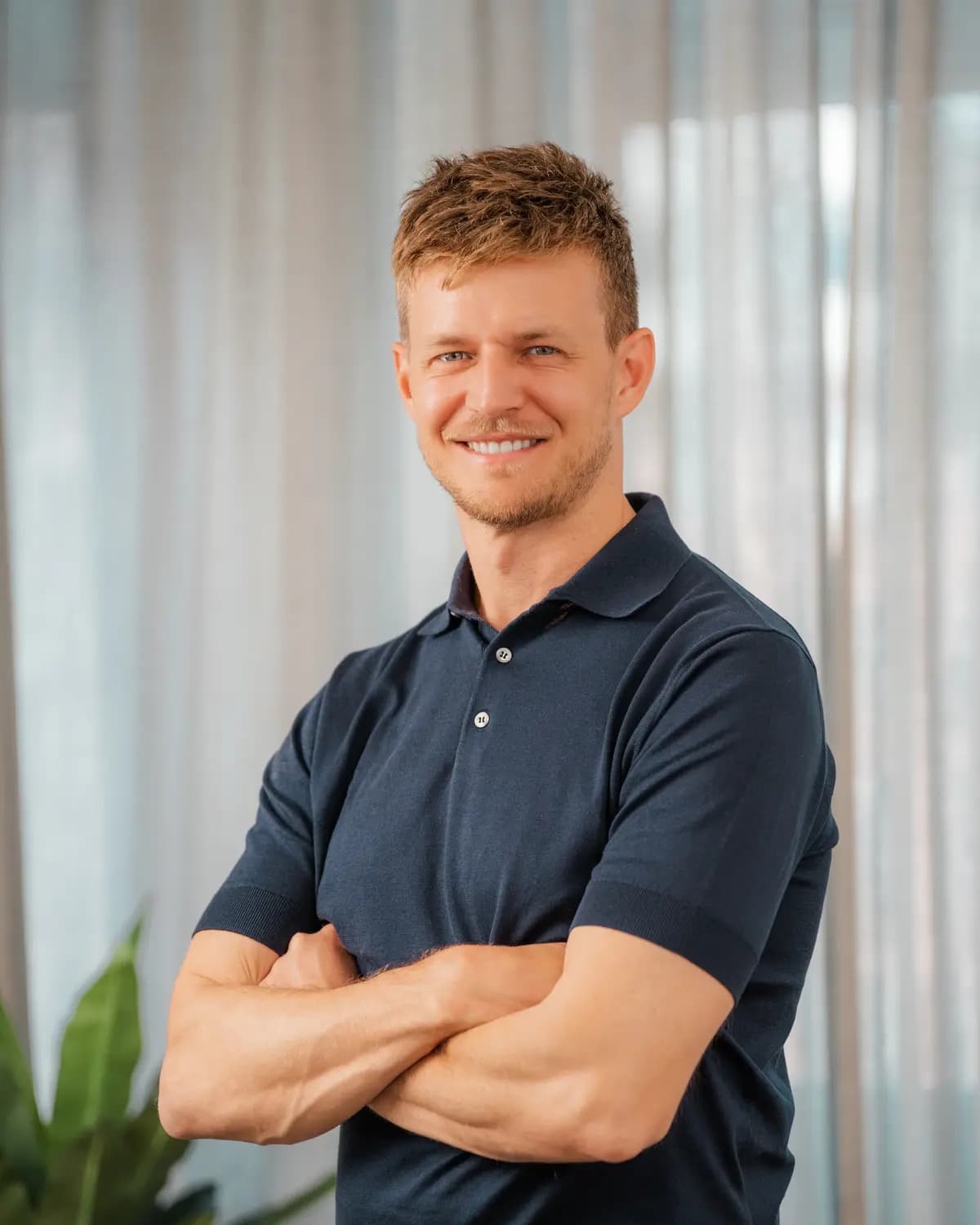
Dr. Fabian Weinschenk
Specialist in plastic and aesthetic surgery (Facharzt)